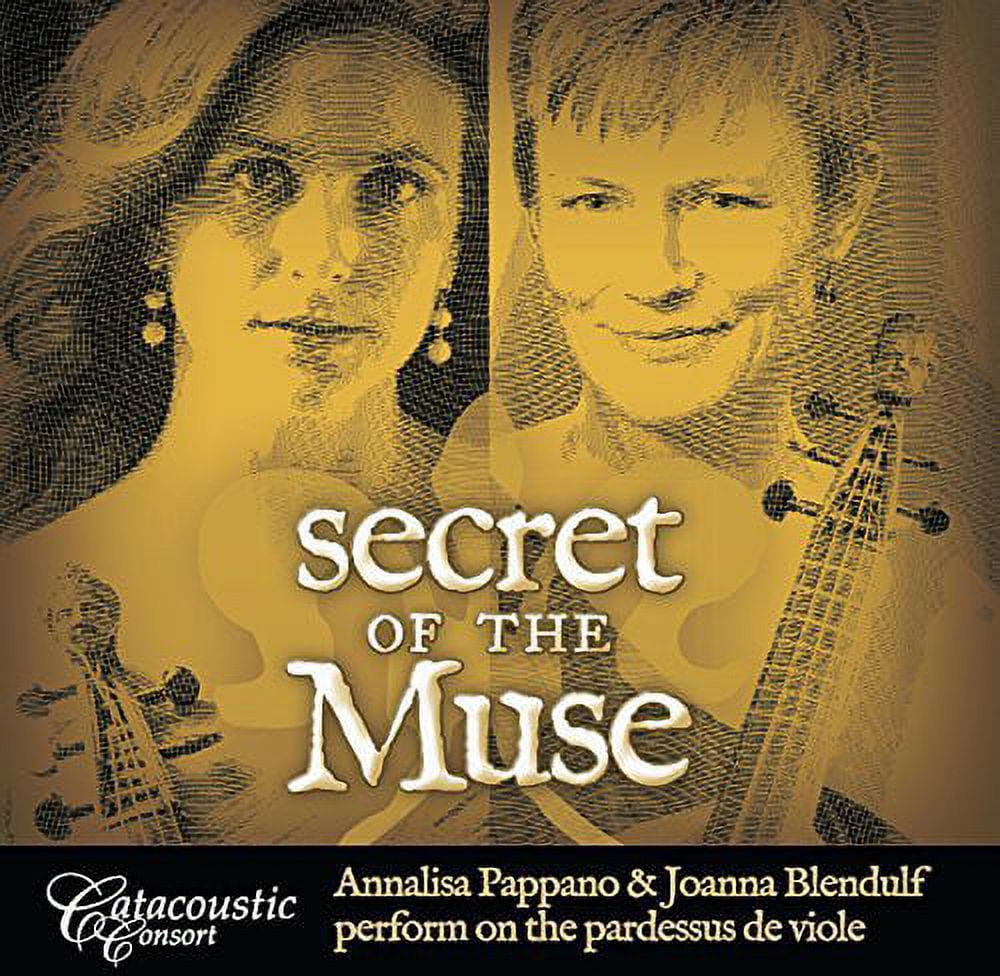
Secret of the Muse
Product details
| Management number | 254262429 | Release Date | 2026/11/07 | List Price | US$5.19 | Model Number | 254262429 | ||
|---|---|---|---|---|---|---|---|---|---|
| Category | |||||||||
The pardessus de viole is the soprano-most member of the viola da gamba family. It was developed and played exclusively in France in the 18th century as an alternative to the violin, which was looked down on as little better than a fiddle for working men. For the upper crust, the pardessus was a much more seemly instrument for a lady: even the daughters of King Louis XV were proficient performers. Another renowned player, Mme Lévi, performed concertos on the pardessus in the famous Paris Concert Spirituel. The pardessus was largely played in homes for private entertainment or for salons - gatherings of intellectuals, artists, philosophers, etc. The players performed music in both the Italian and French styles, which is the beauty of this instrument: it can sound like an Italian violin or a French viol. Music included arrangements of popular opera airs, music composed for the pardessus (collections of suites and sonatas), and arrangements of violin or bass viol music. The music on this recording is a mix of music written specifically for pardessus (Dollé) and music that could be played on either violin or pardessus. The pardessus de viole was built in several variations - six strings (tuned like a treble viol without the bottom D string but with a top high G string), five strings, and later four strings (tuned like a violin). The instruments you will hear in this recording are five-string pardessus, which was the standard type of instrument during it's short-lived (albeit intense) popularity. The five-string instrument is tuned in fourths and fifths (bottom up is G-D-A-D-G) and is still bowed underhand, like a viol. But musical instruments of the pre-Revolutionary aristocracy were considered more than functional tools to produce sound. They were also made to be works of art. Many instruments had elaborate carvings in the scroll or ivory inlays in the fingerboard. Stripes were fashionable in ladies' dress, and stripes often showed up on the back and sides of pardessus. These instruments were custom-made to reflect an individual's personality and style. The pardessus de viole lost popularity and disappeared during the French Revolution, when the fall of the ruling class assured the instrument's demise, since it was so closely associated with the ancien régime. And as music began moving out of private homes and into large concert halls, louder, more powerful-sounding instruments rose to prominence. The once-despised violin, with it's bright, ringing tones, won out over the dark, muted viola da gamba. As Hubert Le Blanc said in 1740, quot;how can one decide to present the viol's merit and have her appreciated, when one is given as battlefield the vast hollowness of a huge hall, which it is impossible for her to fill ... The sound of the viol, heard from far away or in a large space, packed with people and their clothes, resembles the vapour of a spirit of wine which one throws into the air and from which nothing comes down.quot; Produced, edited, and engineered by John Hadden Recorded February 2014 at St. Thomas Church, Terrace Park, Ohio Instruments used in this recording: Guersan, Pardessus de viole, Paris, France, 1754. Dominik Zuchowicz, Pardessus de viole, Ottawa, Canada, 2001. Klaus Jacobsen, Theorbo, London, England, 2005. Cezar Mateus, Archlute, Monmouth Junction, New Jersey, USA. Special thanks: Gregg Hill & Linda Holmberg John Gunnison-Wiseman St. Thomas Church & Carlton Monroe Fred Martens Ingrid Keller & Nate Bick Richard Sutcliffe Alice
Secret of the Muse| Performer | The Catacoustic Consort |
|---|---|
| Music genre | Classical |
| Music subgenre | CD - CLASSICAL COMPOSERS |
| Music release type | Release |
| Media format | CD |
| Original release date | 2014 |
| Edition | Standard |
| Has parental advisory label | N |
| Number of discs | 1 |
| Series title | Catacoustic Consort - Secret of the Muse [CD] |
| Track listing | "Stillness" (3:09), "Deepest Love" (4:20), "Autumn Fire" (3:39), "Gentle Ways" (3:45), "Footpath" (3:43), "Virgin Snow" (2:54), "Darkness" (3:53), "Drifting East" (4:07), "A Call for Beauty" (3:31), "Cradle Song" (4:04), "New Life" (4:15), "So It Is" (2:51), "Sunset Swingset" (3:03) |
| Record label | AUDIO & VIDEO LABS |
| Music producer | John Hadden |
| Track name | Air de l'Amiti |
| Music media format | CD |
| Is edited | Y |
Bestseller ranking
Blue and White Wallpaper



Customers who viewed this product also viewed
Classical Composers

Correction of product information
If you notice any omissions or errors in the product information on this page, please use the correction request form below.
Correction Request Form