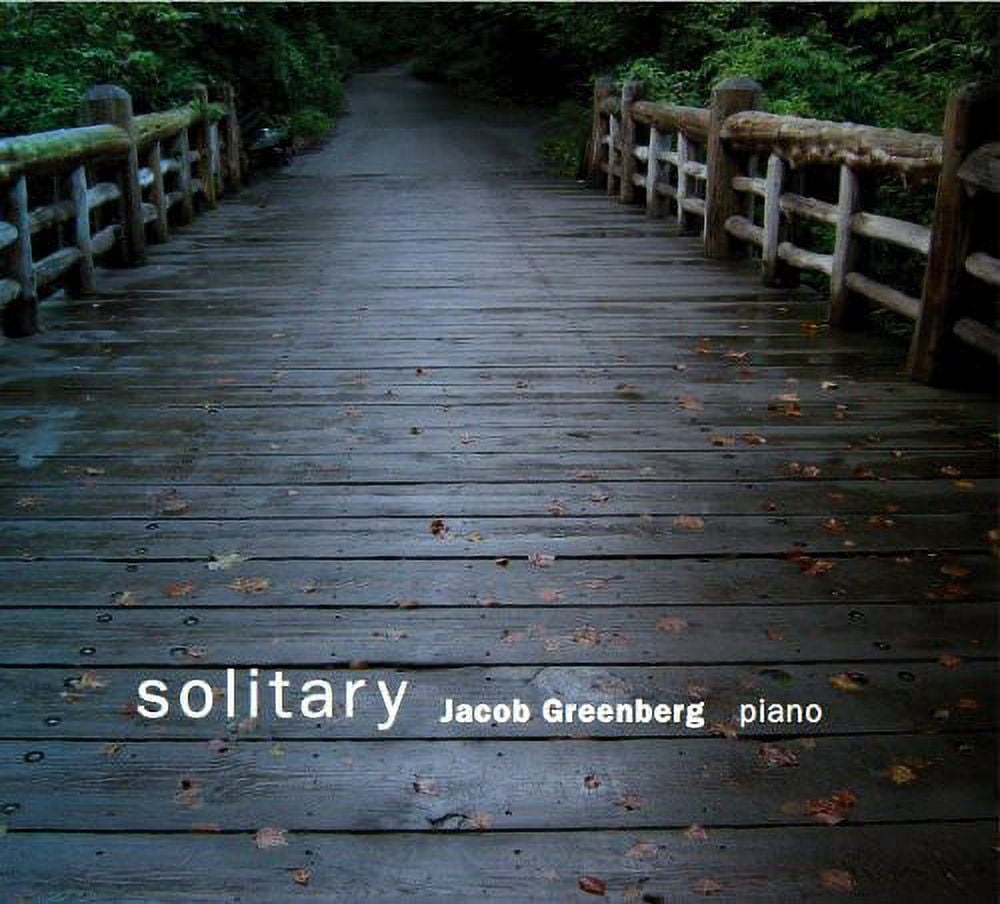
Jacob Greenberg - Solitary - Music & Performance - CD
Product details
| Management number | 254708029 | Release Date | 2026/11/07 | List Price | US$8.41 | Model Number | 254708029 | ||
|---|---|---|---|---|---|---|---|---|---|
| Category | |||||||||
This program spans two-and-a-quarter centuries of compositions that reflect a state of unusual spiritual solitude. A composer's solitary journey can lead to very different places, as each reflects the unique journey of the soul-and a work for solo piano can give perfect voice to such introspection, creating a complete world of sound. György Kurtág began his Játékok (Games) in the early 1970s. This series of ingenious miniatures first served as a cure for the composer's writer's block; it also aimed to be a new method of teaching piano, inspired by Bartók's Mikrokosmos. Kurtág started again from scratch, using basic building blocks of intervals, harmonies, and sometimes primitive methods of playing the instrument (palms, fists, forearms). As the cycle developed-there are now eight books-Kurtág started dedicating the pieces to close colleagues. When I worked with Mr. Kurtág in Darmstadt, Germany, he magically demonstrated, at the piano, some ideal phrasings. I was amazed, and humbled, by how much direction and energy he could convey in a single two-note melodic interval. Kurtág's profound expressive ability is hard-won, the result of much struggle. These varied pieces plumb every element of the music for complexity and effect. Mozart's well-known and endlessly mysterious Rondo in a minor is one of his most unusual solo piano pieces. Relentlessly chromatic, the work alternates between extremes of simplicity and density, often in quick succession. The piece formally adheres to a rondo, alternating a main idea with contrasting material. Notably, the emotional change the listener feels each time upon the theme's return is profound and complex: the fragile melody is weighted by the memory of all that has come before. The piece concludes with a winding coda, and is capped by the simplest cadence imaginable. Schoenberg's 1923 Suite for Piano is the first large-scale twelve-tone work ever written. Schoenberg was so completely energized by his newfound compositional tools that the piece bursts with wild invention in every dimension: melody, rhythm, harmony, and counterpoint. Yet this uncompromised expression is combined with a nominally strict form: the Baroque dance suite. Schoenberg limited himself not just by the formal and rhythmic structure of each dance, but by choosing to only use four versions of a single twelve-note row (with their retrogrades) as material for the entire multi-movement piece. Somehow, the restrictions spurred even greater invention-the many-octave-spanning melody that opens the Gavotte, or the driven, madcap Gigue. Schoenberg's journey as a composer, passing through free atonal composition into dodecaphony, could only have been undertaken by an extreme individualist. Schoenberg's individualism had political and personal consequences, as he later unwittingly branded himself an anti-Aryan intellectual in National Socialist Germany. My Song Without Words After Rilke (a German title better conveys it's debt to Mendelssohn) was composed in stages. I had long been familiar with Stephen Mitchell's wonderful translation of the Sonnets to Orpheus, in particular sonnet eight of the second set, an elegy to a childhood lost. I recited this poem in German several times into a tape recorder, and then made a transcription of each version in pitch and rhythm; I compiled the most naturalistic readings from each take and formed a melody. One of my most powerful early musical experiences took place at my elementary school, where I went many times a week during summertime, alone and always just after dinner, to hit a tennis ball against the brick back wall of the school as I sang to myself. The accelerating and decelerating rhythms of the ball against brick and blacktop formed a contrasting counterpoint to the long lines of my singing, and the effect was meditative. This piano piece, which contains no vocalizing but evokes it, recreates my tennis evenings. Shortly after correcting the printers' proofs for his Gesänge der Frühe (Songs of Dawn), Schumann threw himself into the Rhine River. Though he survived the suicide attempt, this suite of character sketches for piano was the last work that Schumann himself could prepare for publication. He clearly felt close to these pieces, and wished for their dedicatee, the poet Bettina von Arnim, to hear them, as he told her when she visited him at an asylum in Endenich. The opus was written in five days in October 1853, about four months before Schumann's complete mental breakdown. Schumann viewed the pieces as hopeful, but they are a ray of light in a very dark place. They are sometimes desperate and inconsolable, as in the fourth piece, which to me evokes the sweeping current of the Rhine. But the second and third pieces are heroic, and in the first and last, Schumann smiles through tears. These are extremely intimate, private works, and they represent the very best of Schumann's late music, idiosyncratic in spite of the composer's palpable efforts to restrain that quality. The dreamy last piece is brilliantly linked, via a common chord, to the end of the fourth, and the work ends with an odd appoggiatura that sounds like a benediction. --Jacob Greenberg.
- SOLITARY
- Music & Performance
- New Focus
| Performer | Jacob Greenberg |
|---|---|
| Music genre | Classical, Chamber Music |
| Media format | CD |
| Original release date | 2010 |
| Has parental advisory label | N |
| Number of discs | 1 |
| Track listing | Helyettem Kis Virag (?Lovely Greetings to Grete Spinnrad), Harang-Fanfar Veress Sandornak (Bell-Fanfare for Sandor Veress), Capriccioso - Luminoso, Virag Az Ember? (Bornemisza Peter Mondasaibol, III. 3.) (Flowers We Are? from the Sayings of Peter Bornemisza, III. 3.), A Kis Zivatar (The Little Squall), Jatekok (Games), Book 1: ?A Csillag Is Virag? (?Flowers Also the Stars?), An Apocryphal Hymn (In the Style of Alfred Schnittke), A Megvadult Lenhaju Lany (La Fille Aux Cheveux de Lin - Enragee), Fanfarok (Fanfares), Bucsu Kadosa Paltol (Farewell to Pal Kodosa), Rondo in a Minor, K. 511, I. Prelude, II. Gavotte, III. Musette - II. Gavotte (Da Capo), IV. Intermezzo, V. Menuett - Trio, VI. Gigue, Lied Ohne Worte Nach Rilke, No. 1. I'm Ruhigen Tempo, No. 2. Belebt, Nicht Zu Rasch, No. 3. Lebhaft, No. 4. Bewegt, No. 5. I'm Anfange Ruhiges, I'm Verlauf Bewegteres Tempo |
| Record label | New Focus |
| Composer | Jacob Greenberg |
| Music media format | CD |
| Is edited | N |
| Is enhanced | N |
Bestseller ranking
Classical Composers
Correction of product information
If you notice any omissions or errors in the product information on this page, please use the correction request form below.
Correction Request Form