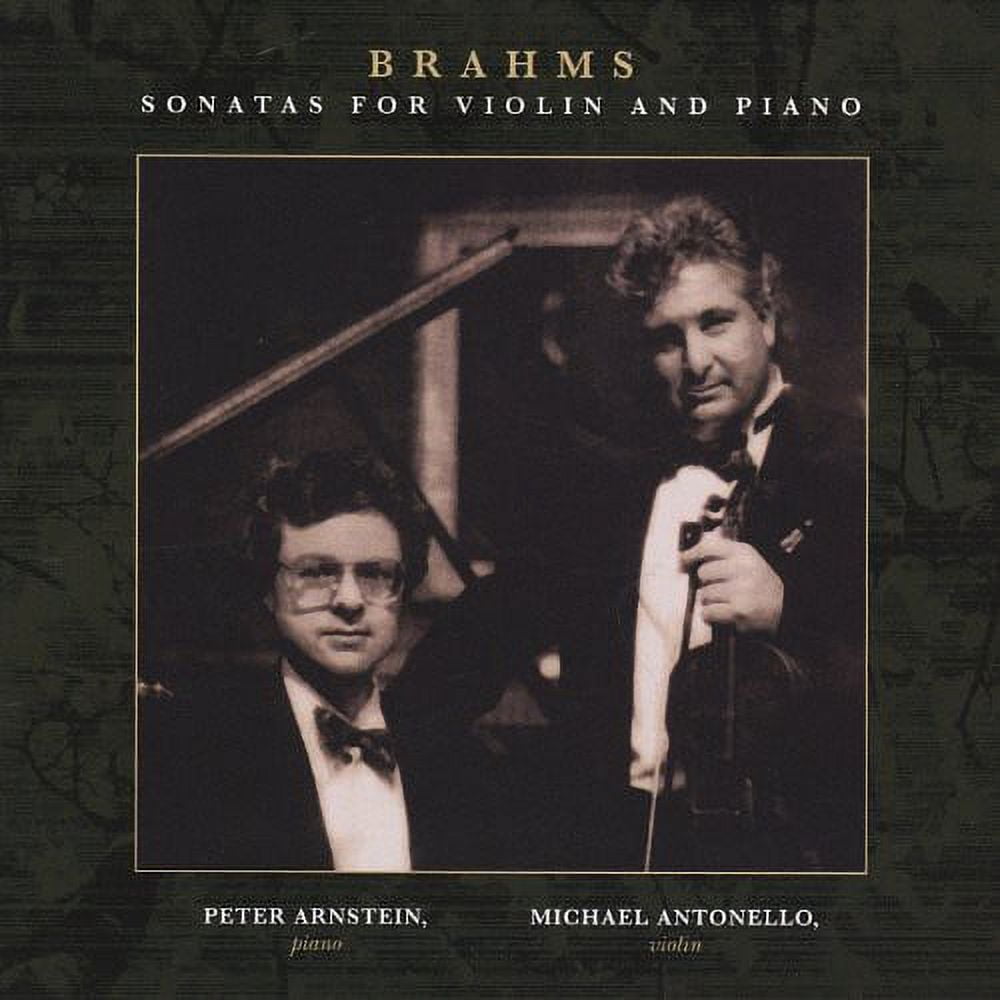
Brahms: Sonatas for Violin & Piano
Product details
| Management number | 254188720 | Release Date | 2026/11/07 | List Price | US$7.18 | Model Number | 254188720 | ||
|---|---|---|---|---|---|---|---|---|---|
| Category | |||||||||
The seminal and traumatic experience of Brahms's life-the slow and tragic death of his mentor and teacher, Robert Schumann (1810-1856)-left a permanent mark on him and his music, and contributed to his lifelong bachelor status. It also stoked a growing desire to lead, more and more, the life of a lone scholar (without interest in seeking a university post), relying on a tiny and shrinking group of friends for their reaction to and constructive criticism of his music. This was unusual, considering his enormous success as a composer and performer. The center of Brahms's little circle and his towering musical inspiration was Robert Schumann, but after Schumann died it was largely limited to Robert's wife, famous-pianist Clara Schumann (1819-1896), and violinist and composer Joseph Joachim (1831-1907). When Joachim gave up composing later in life, Brahms felt that Joachim was no longer helpful, leaving him only Clara. Brahms, a native of Hamburg, came to the Schumanns in Düsseldorf at age twenty with a letter of recommendation from Joachim. Just as Schumann had launched Chopin's and Berlioz's careers with rave reviews in a newspaper for new music (Neue Zeitschrift für Musik, cofounded by Schumann himself), he helped start Brahms's career by writing in a review that Brahms was quot;destined to give ideal expression to the times.quot; Brahms may have been originally attracted to the Schumanns because they seemed more in line with his lower-class ancestry and the opposite of Franz Liszt (for whom he also auditioned) and Richard Wagner, with whom he was uncomfortable because of their perceived pretensions to royalty. Soon Brahms became not only Robert Schumann's favorite pupil, but also babysitter and member of the family. It was a complete surprise when, only one year later, Schumann (suffering from late-stage syphilis and not from any mental illness, as was once thought) threw himself off a bridge and was committed to an asylum. Clara's feeling for what Robert then went through for the next two years is shown when, twenty-five years later, she wrote of her son Felix dying in an insane asylum, describing it as the experience of being buried alive. In the asylum, Robert Schumann continued to compose, to write letters to Clara, and to take long walks with Brahms, during which they discussed all manner of profound musical topics, as before. About eight months before his death in 1856, Robert Schumann appeared to be in remission, and hope grew that he would return home. It was not to be. Brahms's personality from the beginning was that of a scholarly introvert, whose sometimes unexpectedly brusque manner often made him seem unsociable. An example of Brahms's dry and hardly ingratiating wit is an anecdote about him trying out one of his cello and piano sonatas with a young cellist. Brahms kept playing louder and louder, until the cellist stopped to complain that he couldn't hear himself. quot;Lucky you,quot; Brahms replied. Paradoxically, despite Brahms's inability to make easy conversation, his chamber music is dominated by brilliant conversation, especially in these three violin and piano sonatas, as the themes are passed back and forth between the instruments, each speaker-sometimes waiting until the other is done, sometimes unable to resist jumping in as an interruption-gaining energy, inspiration, and passion from the other, until the music almost explodes in a whirlwind, or dies in high-drama tragedy. After Robert Schumann's commitment, Clara decided-in orde
Brahms: Sonatas for Violin & Piano| Performer | Michael Antonello |
|---|---|
| Music genre | Classical |
| Media format | CD |
| Original release date | September 19, 2017 |
| Number of discs | 1 |
| Track listing | Sonata No. 1 in G Major Op. 78: I. Vivace Ma Non Troppo,Sonata No. 1 in G Major Op. 78: II. Adagio,Sonata No. 1 in G Major Op. 78: III. Allegro Molto Moderato,Sonata No. 2 in a Major Op. 100: I. Allegro Annabile,Sonata No. 2 in a Major Op. 100: II. Andante Tranquillo - Vivace - Andante - Vivace Di Piu - Andante - Vivace,Sonata No. 2 in a Major Op. 100: III. Allegretto Grazioso,Sonata No. 3 in D minor Op. 108: I. Allegro,Sonata No. 3 in D minor Op. 108: II. Adagio,Sonata No. 3 in D minor Op. 108: III. Un Poco Presto E Sentimento,Sonata No. 3 in D minor Op. 108: IV. Presto Agitato,Sonatensatz Woo 2: Scherzo - Allegro |
| Record label | CD Baby |
| Composer | Brahms |
| Track name | Vivace ma non troppo, Adagio, Allegro molto moderato, Allegro amabile, Andante tranquillo - Vivace, Allegretto grazioso, quasi andante, Allegro, Un poco presto e con sentimento, Presto agitato, Vivace, ma non troppo, Andante – Poco più animato, Scherzo (Allegro), Adagio mesto, Finale (Allegro con brio), Ballade et Polonaise, Op.38 |
| Digital audio file format | CD |
| Music media format | CD |
Bestseller ranking
Classical Composers

Correction of product information
If you notice any omissions or errors in the product information on this page, please use the correction request form below.
Correction Request Form